Conditions for consistency – how you keep showing up for yourself
(This is part 2 of a series; If you want to read these posts in order, you can find part 1 here.)

“Once a structure exists, energy moves through that structure by the path of least resistance. In other words, energy moves where it is easiest for it to go.”
I’m quoting Robert Fritz who wrote several books about the path of least resistance and the creative process. This principle isn’t just relevant for artists. It can guide anyone who wants to become the creative force in their own life design.
It explains why the structure of your practice matters.
The path of least resistance has nothing to do with laziness. It stems from the phenomenon of desire paths, also known as cow paths or elephant trails (Olifantenpad). We all know and walk these paths that ignore the wishes of urban designers and follow human nature instead. They cut some corners to get more easily to the pedestrian crossing, the bus stop, the subway entrance in the rain…
We have an opportunity to create a consistent practice that works with this law of least resistance.
Rather than wishing we were just a tiny bit more disciplined to stick with an idealised plan, we can plan with our resistance and inner desire path in mind.
By deliberately and mindfully creating the right conditions for your flavour of consistency, you shape a desire path that reliably directs you toward your practice. I’ll be sharing my thoughts and experience about four conditions and what you might want to put in place:
Creating space
Tidy tools
Visible reminders
Making time
Condition 1: creating space – know where to show up.
In the absence of having a studio space (which is the reality for most of us), we need to find ways of converting everyday spaces into a home for our practice. A reflective practice, even an arts-based one, doesn’t need a dedicated space. It’s a great thing to have, but not a necessity.
Create a space that evokes the ingredients for your practice: curiosity, a sense of calm, rest or focus, maybe a creative yearning.
For example, most of us feel more creative when we are in an artist’s studio; seeing colour, textures, and tools tempts us into making. When we step into a yoga studio, we probably find it easier to move into a more contemplative state.
When we respect the importance and power of space, we can build a practice around a kitchen table, our desks, in a favourite comfy chair, or outdoors, in nature. Your practice doesn’t have to be confined to that space, but you should have a default space you go to and sit down in without having to think much or negotiate a lot (with yourself or others). It’s like having a sit spot, a safe harbour to drop anchor.
Austin Kleon writes about his bliss station, a space for retreat and disconnection from the world, the news cycle, technology, the demands of others, and any other distractions.
If you live in a small space, be realistic and tailor your practice accordingly. A studio book is totally doable; steer clear of easel and canvas. Air dry clay might work; a pottery wheel won’t. Stitching yes; a loom probably not.
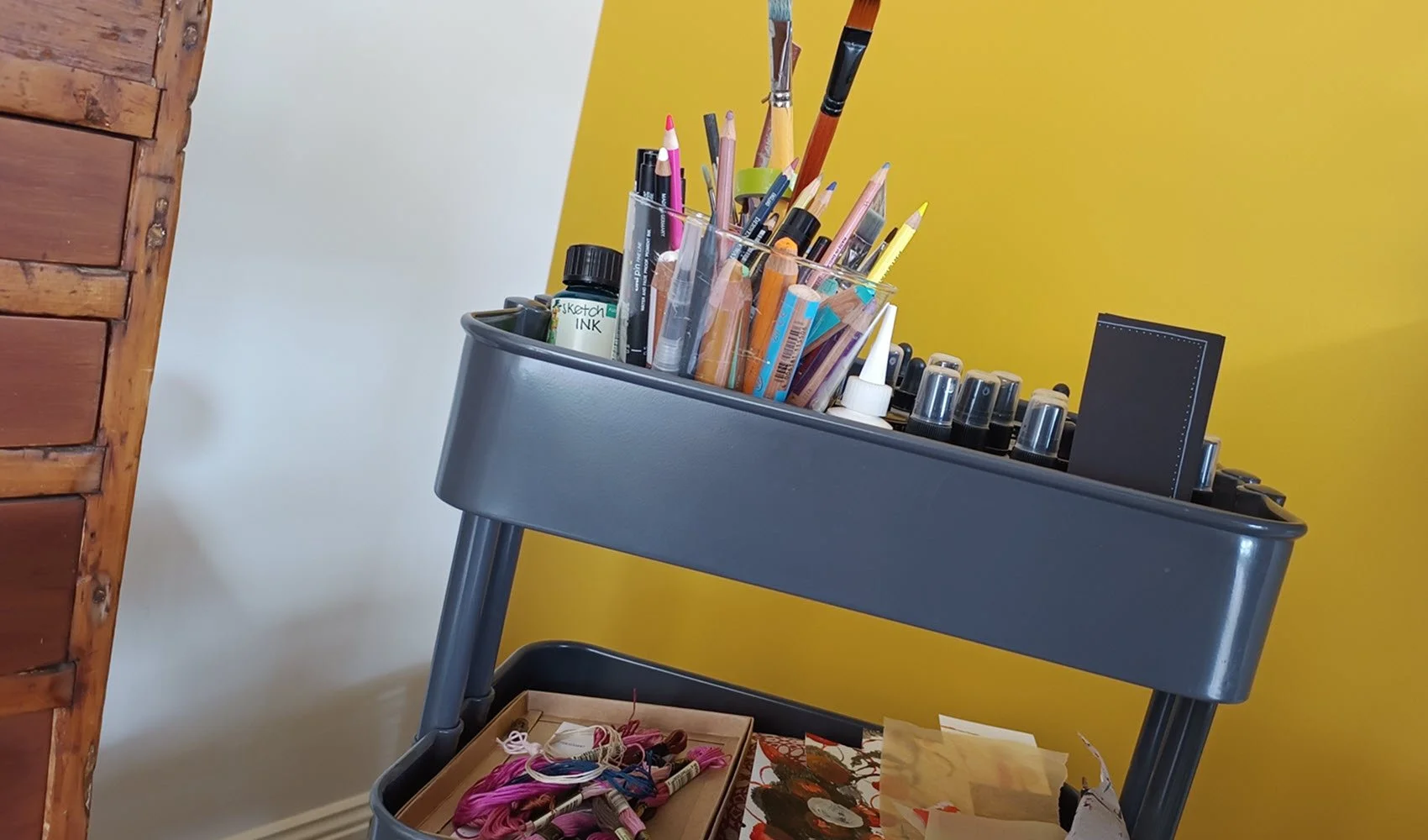
Condition 2: tidy tools, ready and organised
Anthony Bourdain called mise en place “the religion” of all good cooks. It translates to ‘everything in its place’ and describes the practice of readiness of tools and ingredients; the latter possibly cleaned, measured, chopped, sliced and diced. Not having to search frantically for things isn’t only a basic requirement for a smooth dinner service, it also makes for much more joy in the kitchen.
Having our tools ready lets us strike while the iron is hot and makes the experience of turning up for our practice better all-round.
For a reflective practice, mise en place means having paper or your journal, pens that write, colour pencils that are sharp-ish, glue sticks that aren’t dried out – it all helps to get going and to keep going.
Before you jump on the excellent opportunity for procrastination here and delay your practice until you have a perfect, matching set of storage containers, I will share choreographer and dancer Twylpa Tharp’s organisational system. She worked with project boxes: each dance began with a plain box that held everything that went into creating this particular choreography: music, notebooks, videos, news clippings, CDs, photos, ideas scribbled down on pieces of paper… For her, the box represents being organised, committed and connected to a project.
Having an organisational system is especially important if you use a multi-purpose space that you need to convert from one usage into another quickly. Whether it’s a box, drawer, basket… support yourself by having everything you need at your fingertips and in one place.
A practice is more likely to happen when you know where things are and where to go with them.
Tailor your tools to the constraints you’re working within.
Just like we’re not attempting to cook an eight-course tasting menu on a camping stove, we adjust our materials and tools for the context of our practice. That doesn’t mean that you limit yourself to journaling unless you have a purpose-built studio and tons of time. If you know or sense that your practice has to live in the small moments in-between other activities, don’t make your material of choice something that needs a lot of time to set up, dry, or clean away. A stitch journal or found poetry might be more practical than acrylic paints; colour pencils or oil pastels might be easier to use than ink or water colour which need time to dry.
And pick tools and materials you enjoy!
If the materials leave you cold or irritate you (for whatever reason) you won’t feel drawn into your practice. While arts-based reflection isn’t about technically ‘good’ artmaking, knowing how materials behave and learning some tips and tricks can be useful. If you sense that learning some technique or getting to know your materials would make your practice more enjoyable and enticing, spend some time on developing your skills.
Condition 3: keep your practice visible
The old adage ‘out of sight, out of mind’ applies.
Remind yourself that your practice exists.
This sounds like a no-brainer, but when everything is tucked away in drawers or cupboards, it’s easy to forget what we’ve committed to. If you live in a small space, having journals or even art materials sitting around on surfaces may not be practical. But you can have a small reminder stuck on your wall, fridge or bathroom mirror, as a phone wallpaper, in your calendar, or on your bedside table.
Make sure to keep your practice visible in ways that entice you, draw you in; we don’t need reminders that make us feel guilty, we want reminders that we find hard to resist.
Is there a small thing, that you can keep visible without it getting in the way and that reminds you of your commitment to your practice?
I’m lucky enough to have a dedicated space now, but for years my practice depended on these small reminders, like that tin on my desk that held (and still holds) cut out words and whispered, ‘Why not make a found poem, it only takes a few minutes!?’

Condition 4: Make time for a consistent practice
If you wonder whether you have time for a practice, you’re on the wrong path.
You need to ask how you can make time.
The big question is, to schedule or not to schedule? Similar to the rhythm of your practice (discussed in part 1 of this series), this is very much down to your circumstances and preferences.
Most people I’ve worked with agree that they have to plan for their practice.
Just like we plan for exercise, catch ups with friends, or what we cook for dinner, we plan for our practice. It’s not happening automatically or out of the blue and you’ll never get to the end of your to-do-list. The need to plan makes you human.
How you plan is a more personal question. Do you want to have a fixed time each week or month (whatever your resonant frequency)? Do you need to work more flexibly around other commitments? Do you plan in a digital calendar, in a paper diary, with post-it notes, in your personal and/ or work calendar….
Planning that can absorb the shock of life
It’s always good to have a plan B in life. Building ease into a longer-term commitment like an ongoing practice means to pre-negotiate with yourself how you intend to keep going on days with little capacity, energy, time, willpower, inspiration, desire, or motivation.
You give yourself a much better chance to keep going if you embrace the ebb and flow of life. There’s no point hoping that you’ll negotiate effectively with yourself on these low-capacity days. When your carefully scheduled 30-minute slot gets gobbled up by life, have a plan in your back pocket to honour your commitment with a 5-minute version of your practice.
For my low-capacity-days I have what I call a tiny practice.
It’s a process of creating found poems, something that’s quick and easy, and needs very basic tools (just scissors, glue stick and some words). I’ve also learned from experience that found poetry is a good way for me to express what’s going on. Often, I’ll get to the bottom of my low capacity or the meh-feeling which in turn helps me choose the appropriate action to move forward.
This tiny practice has also sustained me over longer periods of low-ness, weeks and months when life didn’t go to plan and a more expansive practice didn’t feel possible. It’s much easier to re-launch your practice from a tiny trickle that you’ve managed to keep alive than trying to re-start after your practice has dried up entirely.
What could be your tiny practice that doesn’t need lots of space, time, capacity or stuff?
So, your four conditions for a consistent practice are:
Space: know where to show up.
Tools: the right tools for you, reasonably well organised.
Visibility: keep a visible reminder of your practice.
Time: make time, plan for your practice and have a Plan B for tough times.
Start by thinking about these areas. Which ones are easy for you? Which ones might need some imagination and preparation? Don’t try to create a perfect blueprint before you start - that’s just another procrastination trap!
Start with something and experiment. Then adjust, tinker, amend, play.
This is part 2 of my series on consistency.
In part 1 of this series, I’ll invited you to define what consistency means for you.
In part 3, we focus on moving from intention into doing. I’ll offer you concrete ideas for shaping, cultivating and sticking with your practice through the ups and downs of life.
If you yearn for more consistency in your life and want to show up for yourself and for what matters to you, let’s chat.
I offer arts-based and trauma-informed coaching in a 1-on-1 setting: book a free Discovery Call or find out more here.
If you’re curious about building a reflective practice that you can stick with, check out my group programs: get in touch or look at current programs.