How can I be more consistent and show up for myself and for what I care about?
This is a question and deep desire clients bring when working with me, whether in 1:1 coaching or in my groups. In the context of my work, consistency is often about cultivating a creative or reflective practice, or about making time for important relationships. It’s about being not just consistent at work when we show up for others, but being equally consistent in showing up for ourselves.
Many of us yearn for more creativity or time for reflection in our lives. We want to protect our attention and create spaces where we can be playful, curious and inquisitive. We want to get out of our heads and use our hands and our senses. We seek rest and a break from the relentless information flow, much of which is keeping us in a perpetually alarmed and activated state.
People want to be reflective (and reflexive) rather than reactive.
Committing to a practice is a way of steadying ourselves as we adjust to seismic shifts and ruptures in the world and its systems and, on a smaller and everyday scale, navigate the unpredictable course of our own lives.

Cultivating an ongoing and consistent practice
In our bones, we know that having a regular practice, having a way of examining and aligning our outer lives with our inner worlds would do us good. People share with me that having a consistent reflective/ creative practice is also a way of dipping regularly into joy. Still, it’s really hard to build something sustainable and to keep going with it.
If you look up synonyms for consistency, you get quite a range of words: uniformity, constancy, regularity, steadiness, reliability, dependability.
Defining what consistency means for you might therefore be a good start.
Without knowing what we’re aiming or hoping for it’s hard to make the first step and impossible to put the right structure in place to keep going.
Let’s start here: consistency versus frequency
We’re exposed to the productivity cult, gamification and apps designed to track our unbroken daily streaks. Suddenly we care more about our streak record on Duolingo than whether we can have a conversation or order breakfast in the language we’re learning so diligently.
We live in a world that makes it easy to default to daily as the yardstick for consistency.
But: exercising twice a week is as consistent as exercising daily, but the latter is more frequent.
You might be tempted into starting too big and expect too much, but it’s so much better to start small, have some easy wins and build from that.
If we start small enough to stick with our intention, our brain collects evidence that we are the kind of person who can follow through. It’ll learn that effort is worthwhile, that we can change things, and trust ourselves.
Hence, a critical step in shaping a consistent practice is to develop an idea of frequency that feels both good and doable for you, in your real life, not in an imagined life.
I for example love learning about artists or writers and their creative practice. I use it as inspiration, I might steal some ideas, but they’re not the blueprint for my own practice; after all I’m not a full-time writer or artist.
Sometimes, the step of finding your frequency needs some experimentation before you know what is actually feasible. So, I’d encourage you to define a series of experiments around frequency. Don’t overthink it and try not to get discouraged when your first attempted rate of practicing is not sustainable. But if you want to feed your brain small wins, start small and enjoy feeling accomplished when a more frequent practice seems possible. Depending on your life circumstances, this could mean to start with monthly, or weekly; daily is a lot for most of us.
Don’t forget that whatever frequency you arrive at, it’s not set for life. It’ll change with different chapters and seasons of life, with your energy, circumstances, interests, demands on you and your time.
Once you’re clear on your ideal frequency, it’s worth considering consistency versus uniformity
Doing the same journaling practice, using the same prompts or structure weekly, maybe writing for the same amount of time is both consistent and uniform.
Doing some form of journaling practice weekly where you vary the prompts you use or how much/ how long for you write is also consistent but less uniform.
Cultivating a reflective practice that consists of journaling, some artmaking, going on a reflective walk and maybe other approaches is consistent and even less uniform.
Some widely known practices happen to be quite uniform. Julia Cameron’s Morning Pages, for example, prescribe the modality (stream-of-consciousness writing), the time of day (morning), the amount/ length of time (3 pages). Maybe some of the famous practices are so widely known because they are quite tightly structured? It’s much easier to communicate or ‘teach’ such a disciplined practice than something much more fluent. It’s also much easier to follow these quite strict instructions and feel that you’re doing it right.
You decide how much uniformity you need or want in your consistent practice.
Do you find variety stimulating, does it keep you engaged?
Do you like to orient toward a set structure, does this feel supportive?
One isn’t better than the other; they’re just different preferences.
Sometimes, when we start something new, tighter guardrails can be helpful. Too much flexibility can be too much; we’re not quite sure where to start or feel overwhelmed by the decisions we need to make before we begin. If you start with something quite well-defined, remember that you can loosen your practice and make it more varied, less uniform, as you become comfortable in it. And for some people, a tightly structured approach is not only right at the start, but perfect and exactly what they need and want in the long run.
Others might find a more prescriptive practice too restrictive or feel easily bored. If you recognise yourself in this, start with a small range of prompts, practices, ideas that feel both stimulating and manageable. As you begin feeling more at home in your practice, you can add more prompts, modalities or approaches and make your practice as varied and engaging as you want it to be.
You might already know your preference around uniformity, or you might need to run a few experiments to find out whether your practice needs to be a more uniform and homogenous space where you stick with a small number of tried and tested approaches or whether you prefer greater variety and want to mix things up to stay engaged.
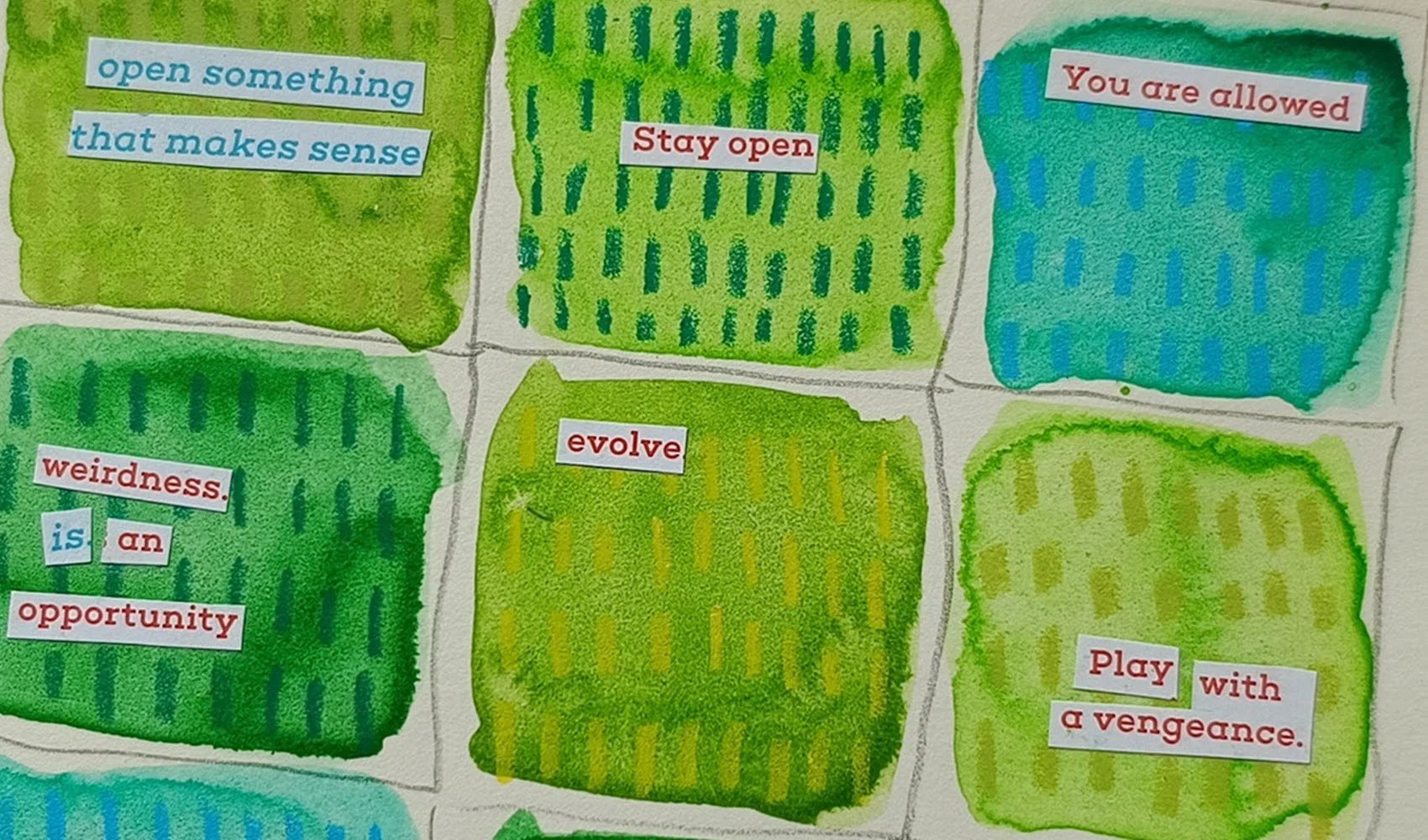
Sidenote: encountering boredom is part of any practice. It’s worth exploring your relationship with boredom and expand your capacity for it, especially in a world of over-entertainment and distraction where being truly bored becomes increasingly hard. Boredom is after all an important ingredient in creativity.
Consistency is rhythm
I encourage my clients to think about rhythm when shaping a consistent practice, whether that’s a creative or reflective practice, regardless of their chosen modality.
In music, rhythm describes the arrangement of sound, silence, and emphasis over time, acting as the underlying structure and flow of a piece.
Rhythm is about repeated patterns; it allows us to go faster when we can or want to and to slow down when needed.
When we shape our practice through the lens of rhythm we deliberately build in pauses and design for more and less intense periods in life.
We expect times when we touch our practice briefly or lightly and times when we dive deep. We anticipate an ebb and flow depending on our circumstances, energy levels and time budgets. When we are curious about the right rhythm, we’ll shape a practice with in-built ease and wiggle room.

Rhythm responds to change and the messiness of life
When we have to make an important decision or are going through a hard time we might have greater need for reflection:
We might need to gather ourselves, explore options and possibilities and organise our thoughts and emotions.
We might have a need to somehow document this period. Especially documenting times of struggle and adversity can be useful as we can later remind ourselves of how we got through. This strengthens resilience.
At the same time, tough times leaves us often depleted of energy and with little time or shattered focus.
When you understand your practice as a flexible support structure that offers you rhythm, it’ll be a solid companion through such times instead of becoming a burden or something else you feel you’re failing at.
Rhythm makes it easier to find your way back after a hiatus and some time away from your practice. Having been on a break is part of the expected rhythm, not a personal failure you struggle to come back from. It allows you to start small and gently if that’s what you need or pick up where you left off with a big gesture and deep-dive session. Having more than one way back into your practice helps and I suggest to my clients to fully expect disruptions and a time where they’ll disengage and have a think about how they can revive their practice beforehand.
In my experience, a rhythmic practice is far more compatible with modern life than a very regimented one.
This is part 1 of my series on consistency.
In part 2 of this series, I’ll invite you to explore your conditions for consistency.
In part 3 we focus on moving from intention into doing. I’ll offer you concrete ideas for shaping, cultivating and sticking with your practice through the ups and downs of life.
If you yearn for more consistency in your life and want to show up for yourself and for what matters to you, let’s chat.
I offer arts-based and trauma-informed coaching in a 1-on-1 setting: book a free Discovery Call or find out more here.
If you’re curious about building a reflective practice that you can stick with, check out my group programs: get in touch or look at current programs.