This creative experiment invites collages that are less like a vision board or patchwork of individual images, but create whole new scenes, creatures, landscapes, or worlds. These new creations can include abstract shapes or combine concrete elements (or both, of course). It’s also an invitation to work with real materials, paper, photos, magazine images, not digital collaging.
I’ll share with your the basic steps of the collage process and then, I’m inviting you into a creative experiment, the emergent collage, a process of my reflective practice that helps me make sense of things.
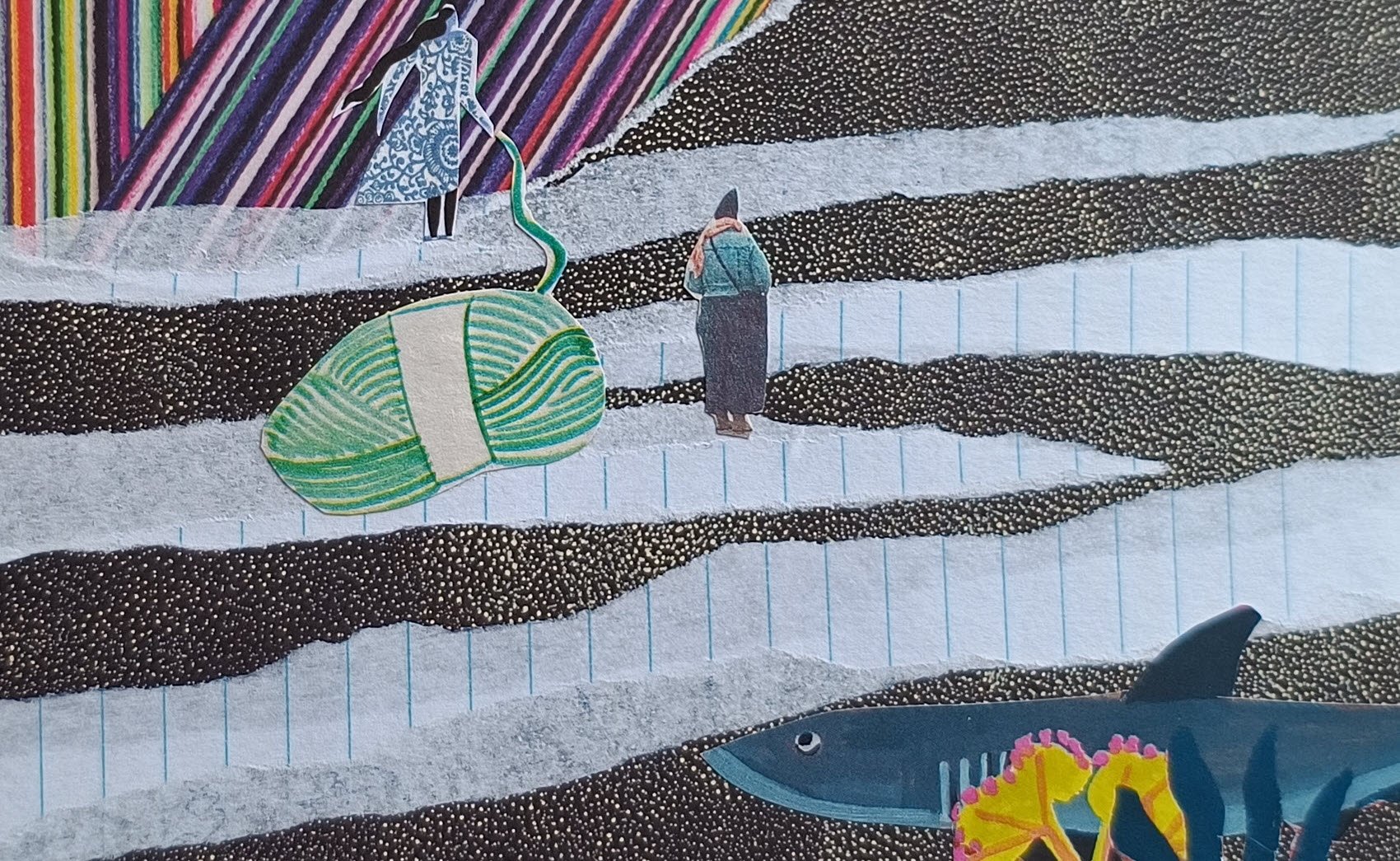
Collage is an easy artform to get started.
Should you consider yourself not creative or artistic, collage is a good way to reacquaint yourself with your creativity. Using existing images can reduce the pressure of needing to be able to make, draw, or paint the things you want in your collage; instead your creative act focuses on selecting and arranging found elements. At the same time, with more confidence and practice, collage can be elevated and developed into a complex artform.
Collage is a very tactile artform.
You can experiment with different sensory experiences of your source material: glossy or matt magazine images, photos, book pages which can range from old books (second-hand, no first editions that would make a book collector cry!) to paperbacks to glossy coffee table books; you can work with different paper qualities, thin tissue paper, rice paper, card, thick handmade paper with distinct fibres or even plants and flowers integrated. You can incorporate fabrics, yarns, man-made elements like foil, bubble wrap, packing materials, or nets you bought fruit in. This sensory experience gets you out of your head.
Collage activates your imagination
As you explore how different elements could be combined, you’ll access imagination quite easily. It’s easy to combine the image of a body with a different set of legs or a new head; you can create hybrid creatures, form landscapes that wouldn’t exist in nature, or transplant rainforest trees into the plains of the tundra or to a mountaintop in the Himalayas.
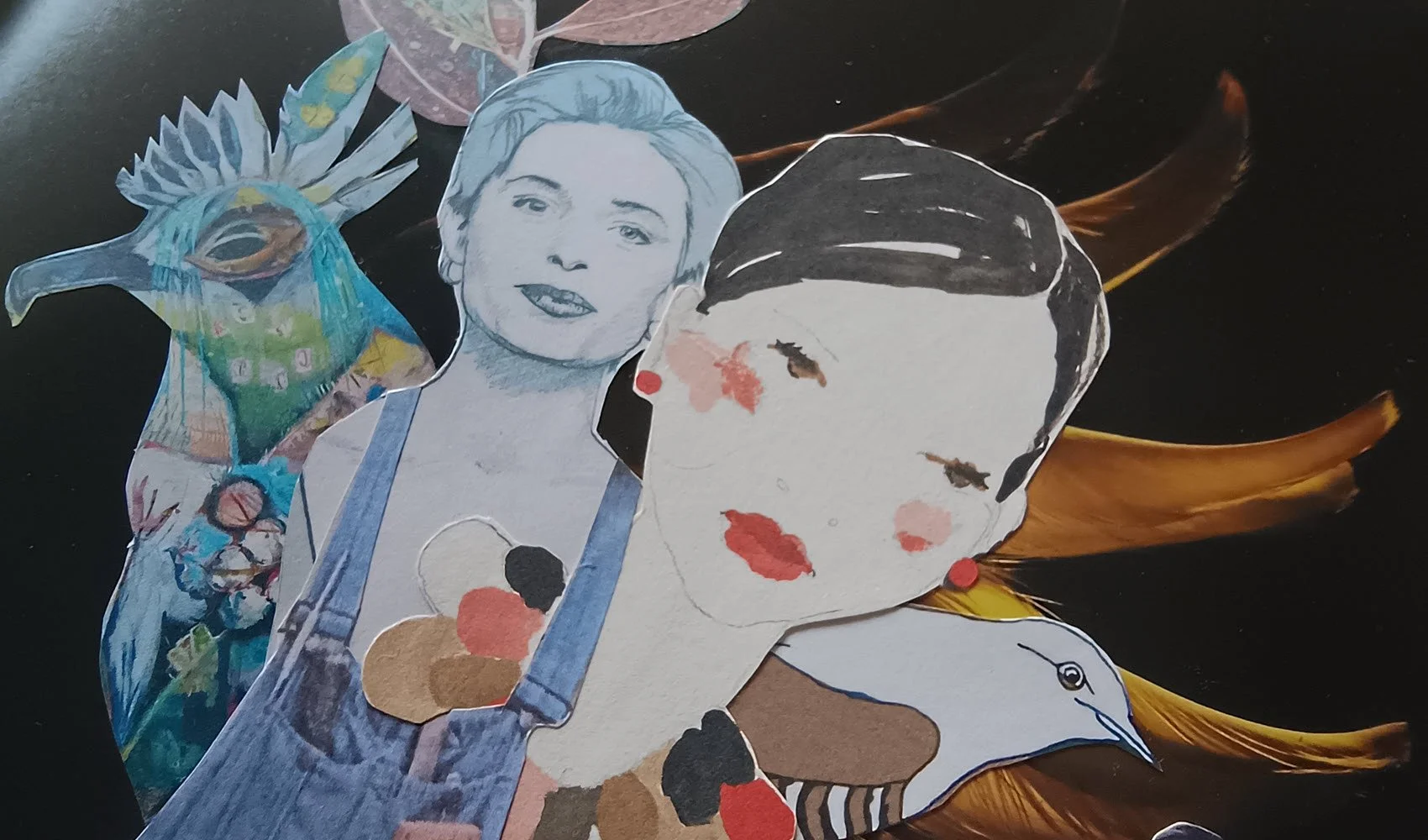
This collage highlights how easy it is to create imaginary figures and express myself in a way that exceeds my own drawing skills.
Not sure how to start? The basic steps of making a collage:
Gather: browse through your image materials – try to stay open, you don’t yet need to know what an image represents or how it will come together. As you look through materials, notice what catches your eye, where do you feel curiosity, resonance or dissonance?
Curate: begin making choices. You might have a pile of images that feel like a definite Yes, others are a Maybe. And some might already end up on the cutting floor. You might begin to see how certain elements could be combined or form something new and interesting.
Compose: this is the state of compositional play. Cut or rip your images, start layering them. Consider qualities like order versus chaos; busy and full space versus empty space; the scale of elements, and whether you want to create a collage with visual depth or are you more after a flat result? What is background versus foreground? Is there a clear focal element? You’ll naturally reduce your images further and let go of those that don’t seem to fit or belong to your collage.
Attach: now it’s time to fix images in place. Pick your base, a large piece of paper or cardboard, you can of course use a wood panel, a canvas, index cards, glue a collage into a journal or sketchbook… Consider how much white space you want, this informs the size of your base. You can use a glue stick, craft glue for paper and textiles (don’t use wood glue, it will discolour your paper elements!), matte gel medium or mod podge.
Narrate: when we make art for sensemaking, this final step is about personal meaning-making. Start by describing what you see. Are storylines emerging or a clear title for the collage? What are you learning from your process, what have you come to know or understand?
Your creative experiment: the emergent collage
An emergent collage is a collage where you slow down the process of making and change elements as part of your meaning-making process. Here’s an example of one of my collages to show how much a piece can change between an early version and the final composition.
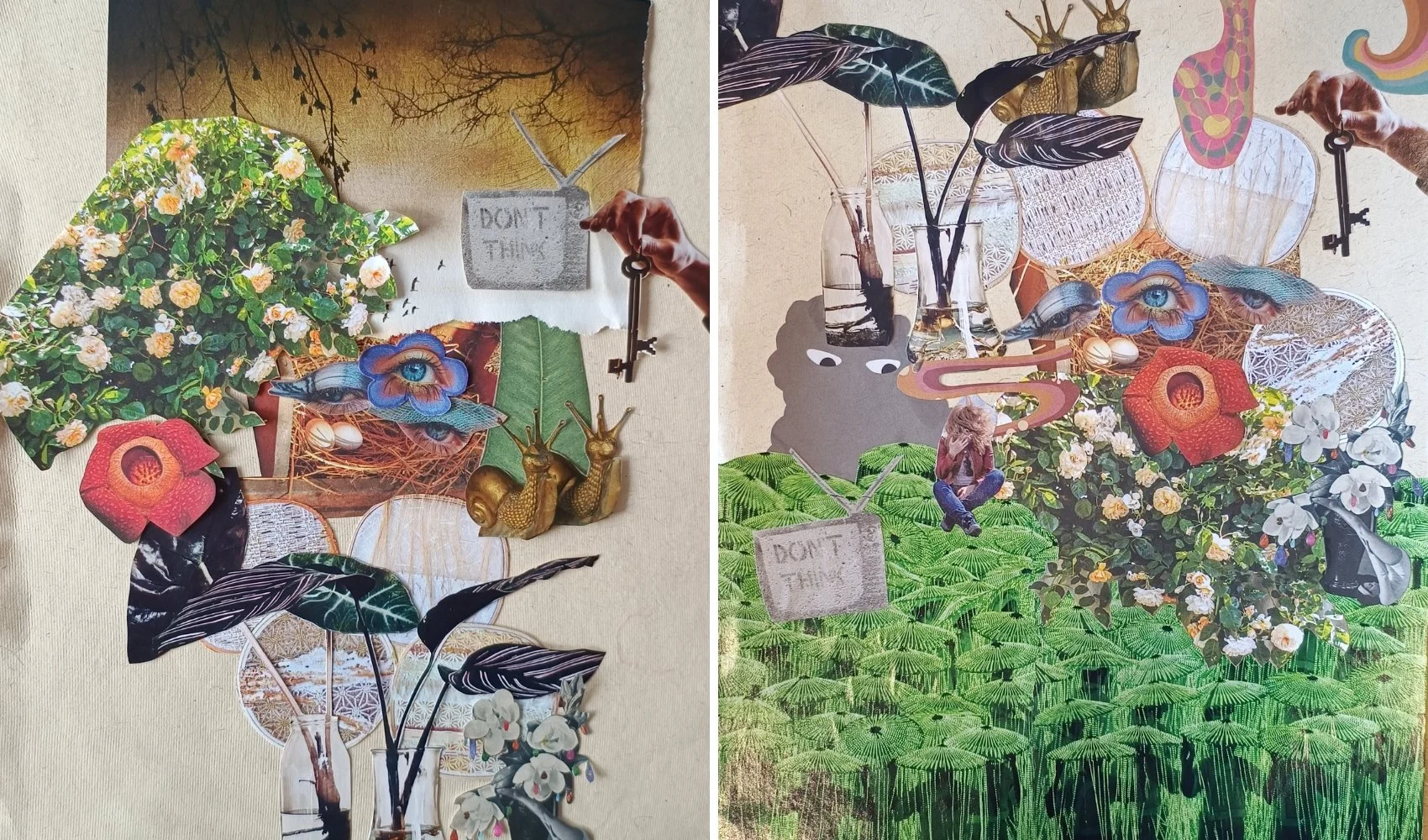
When I make a collage as a part of my reflective practice, the stage I really hang out in is ‘Compose’.
I spend a lot of time shuffling things around and discovering multiple meanings. I notice how seemingly small changes can create a significant shift in a collage and its meaning. I can play with simplicity and complexity, with realism, imagination and fantasy.
Emergent collages let us see and try out possibilities.
This process is led by instinct, intuition and curiosity. What if? becomes a guiding question. It’s such an easy imagination practice as everything is movable and any experiments can easily be undone. What if the teapots are stacked into a little tower instead of floating side-by-side?
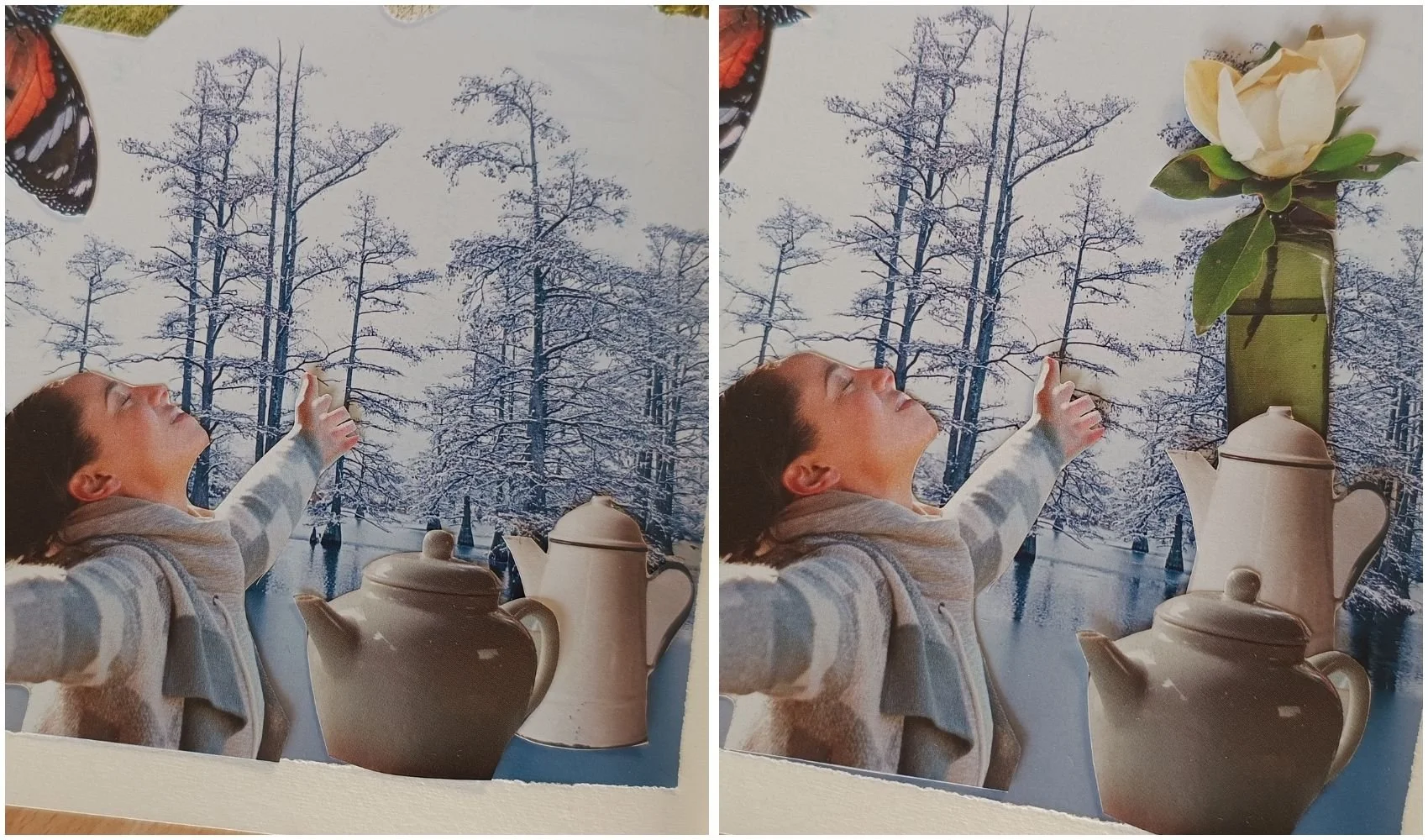
An example of compositional play.
I might take notes while shuffling elements around. This helps me notice whether elements of my collage create shifts inside me, or stir up thoughts, emotions, memories or even an aha-moment. Different compositions bring up new storylines, change the relationship and tension between elements and can introduce new symbolic meaning or roles for individual parts or characters in my collage. This is a very iterative process, and I might take photos of interim versions that feel like a possible composition, and then I keep trying out other arrangements.
I can hang out in this space over a few days.
This slow and prolonged process might require some getting used to. We’re mostly conditioned to finish things, tidy up and move on to something new.
Instead, I keep the elements unattached and put the collage somewhere where I can see it. Ideally on a table or sideboard. Remember to consider drafts from opening windows, pets or kids that might ‘rearrange’ your emergent collage. I once vacuumed next to an emergent collage I had parked on the floor which wasn’t ideal...
As I rearrange my collage, I keep taking photos and notes to capture how new composition change the meaning of the piece or stimulate new questions or insights. Some changes are made in just a few minutes, as I walk past the collage and spot a new possible composition. It’s not about sitting down for hours.
It’s also worth noticing what gets removed and ends up on the cutting floor and why. Walk around your table to see your work upside down or take a photo to look at it from different angles, zoom in and out.
At some point, I feel that the collage has reached its final composition and I glue things down. For me, this is a felt sense of resolution, being complete; everything is in its place and makes sense. Through practice you’ll learn what this felt sense of completion is for you.
It’s an integrative process during which different parts, ideas, stories, values become a more cohesive whole.
Tip: If you have space, keep your collage visible for a little while after you’ve finished. This will also help you continue your sensemaking process and catch new insights. If your collage has unearthed a clear action or informs a choice you want to make, keeping it visible acts as a good reminder to follow through on your intention.
If you yearn for more creativity in your life and want to use it for self-reflection and self-knowledge, let’s chat.
I offer arts-based and trauma-informed coaching in a 1-on-1 setting: book a free Discovery Call or find out more here.
If you’re curious about building a reflective practice that you can stick with, check out my group programs: get in touch or look at current programs.