Creating in books: the spine of my practice
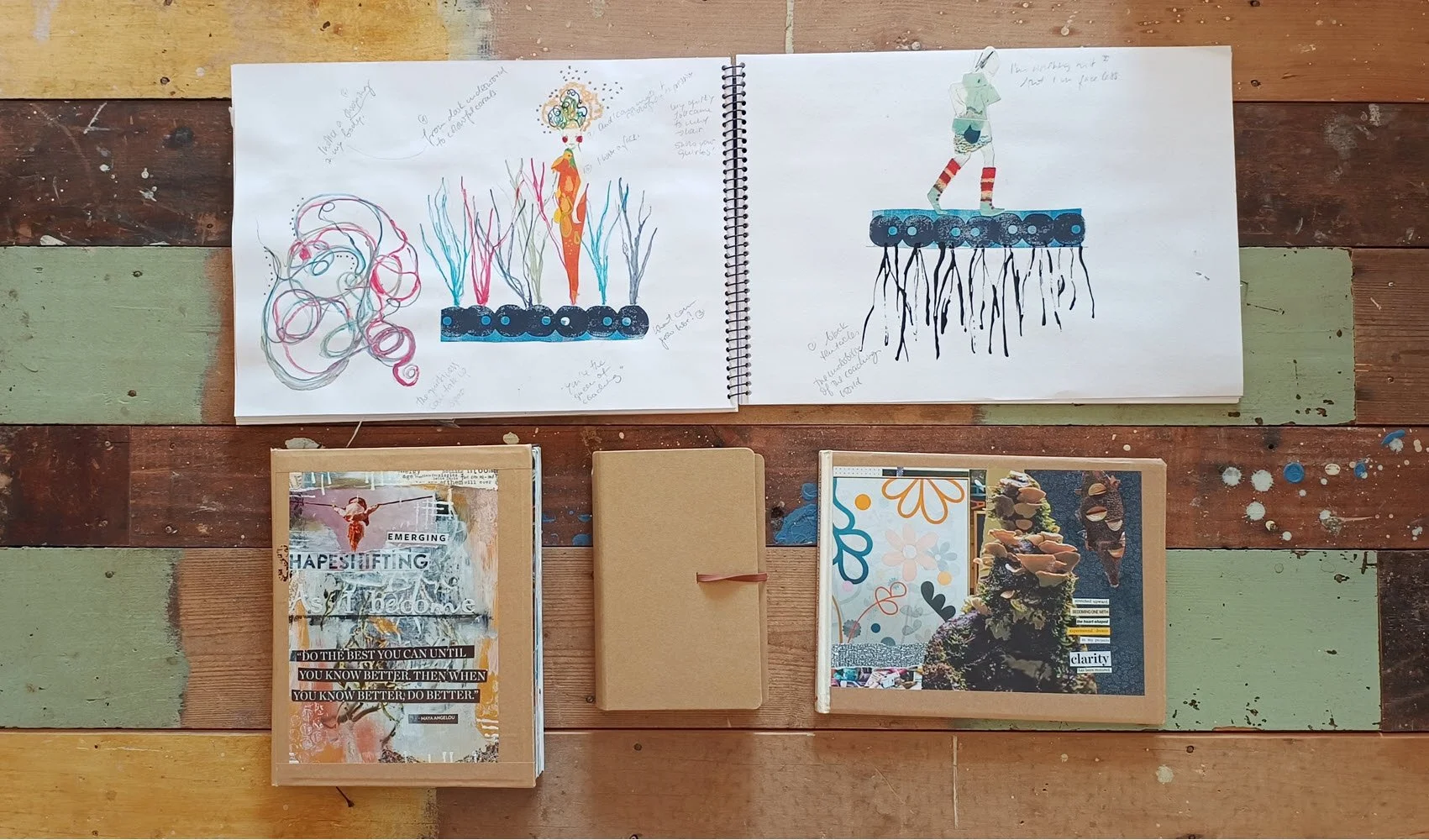
A few years ago, I felt a bit disconnected from my work, maybe a bit exhausted, disillusioned… we’d just emerged from the pandemic, and my work had changed beyond recognition.
I remember my supervisor asking me this simple question:
What’s your creative practice like at the moment?
I realised, that it had slipped away from me; it felt dormant. Between shifting my work to largely online, navigating COVID and relocating, I had stopped sitting down regularly to make things with my hands.
I knew, however, that I was always more creative in my work when my own creative practice felt alive and full of energy.
And by being creative in my work I don’t just mean bringing art into coaching or introducing clients to creative processes. I’m also more creative in terms of developing attuned hypotheses, coming up with the right question or invitation in the right moment, being able to switch more seamlessly from expanding a client’s inquiry towards new possibilities to consolidating it to manageable choices.
That same day, I pulled out an old chemistry book and started creating in it. And since then, books are part of my practice in many shapes and forms: sketchbooks, Studio Books, altered books, small artist books, simple handmade books that don’t require bookbinding skills or tools…
Books are a solid container
There are many reasons why having a solid container for our creative/reflective work is useful.
Few people have the luxury of a studio space; using books as a container for your practice is often more suitable to small or shared spaces. A book is easily stored away when you’re finished with your practice or if you want to keep our practice private.
When we work with themes that are complex or bring up difficult things it’s important that we can temporarily step away before we return when we have more capacity or when things had a chance to settle in us.
For some of us, life and/ or our brains are so busy that it sometimes feels good to ‘put a lid on it’, i.e. close the book. Take a break without losing any ideas or thoughts.
If you choose the right size, a book makes for an excellent travel companion, good for lives set up around travelling or moving regularly between places.
I use small books when I need portability and also when they are created around a topic or during a time when I need things to be well contained to avoid disappearing into doom and gloom.

Books hold your process
Books aren’t written or filled in one sitting. By design you’ll keep coming back to your book, giving your reflections and creations time to percolate. Working through a book page by page (and it doesn’t have to be done in a linear, front to back kind of way) naturally documents a process.
Sometimes, when I return to one of my books, I’m surprised and delighted by what I’ve created. Other times, I paint or glue over it because for one reason or another it no longer speaks to me. And sometimes I simply add a small detail, a mark, or a word to the page and it feels more complete.
I let some books be unfinished. Some are organised, others feel messier; some pages feel quite considered and intentional, others are full of spontaneous expressions.
When a book becomes a little messy or wonky, when it no longer closes neatly, when the spine cracks and paint bleeds through the paper, that’s when it starts feeling a little bit more like real life.
These sorts of books aren’t about perfection or doing it right. We don’t focus on the beautiful end result, even though in the end, the result is often beautiful.
Whether you use a sketchbook or start altering an existing book, make your books a place where your deepest inquiries, your curiosity and creativity can come to life without being watched.
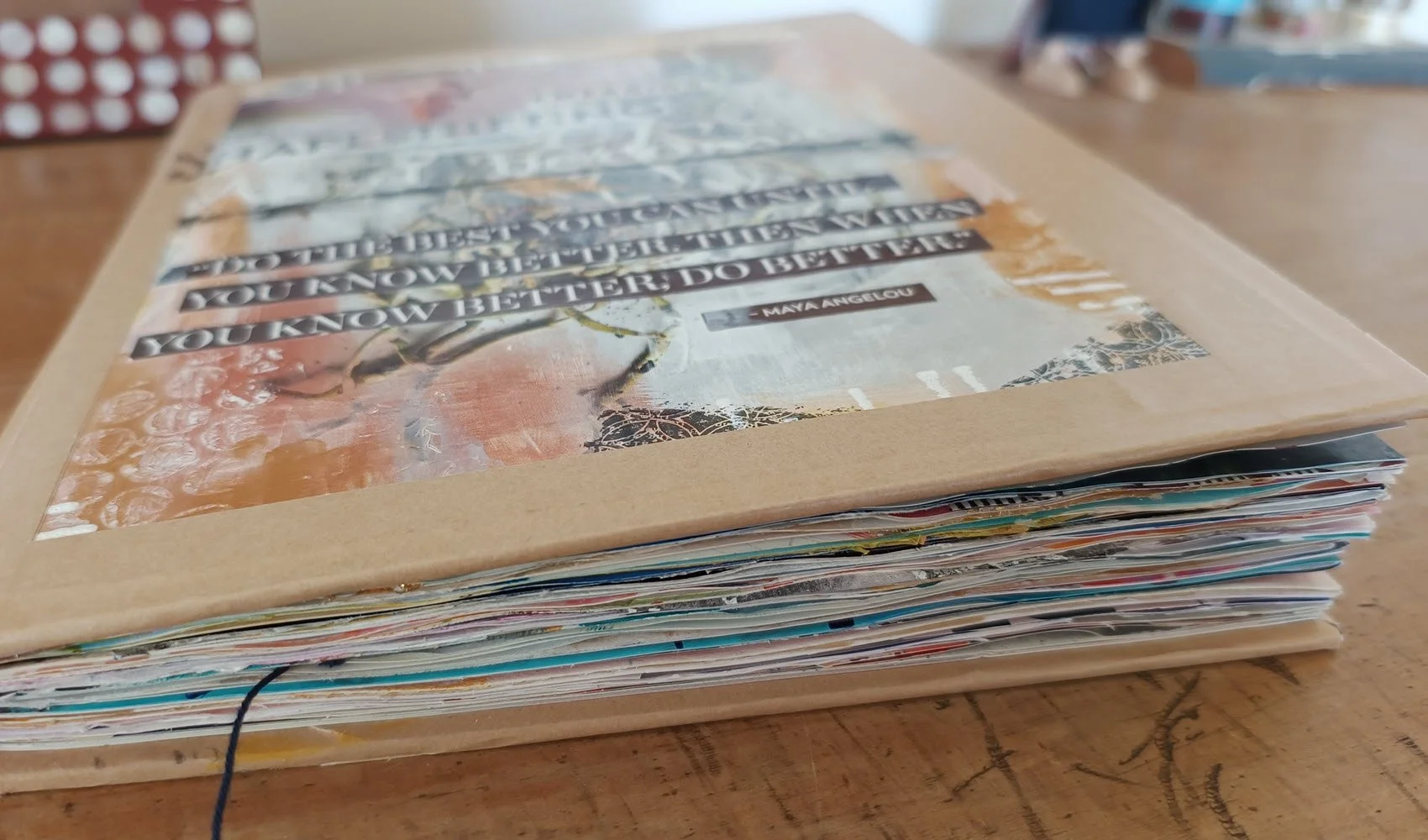
Books become a visual narrative of your life
The wish to rewrite some stories and explore alternative plot lines comes up often for my clients.
Maybe the format of a book lends itself naturally to this retelling?
Humans are storytellers. We need stories to make sense of our experiences, to share knowledge and wisdom. We use them to connect with our community. When humans started printing and binding books they had found an alternative to oral storytelling. Stories could now travel farther. Books also allowed people to preserve their stories beyond their lifetime.
A book holds your writing, artmaking and reflections in relationship to each other.
You notice how its pages begin to tell a story or maybe they offer you a thread you can follow. It’s easier to notice progress or change whether it’s more about subtle shifts or significant revelations.
For me, a chronological order is helpful, and I quickly noticed that I like working in books methodically, front to back. When I create in my book in this way, it’s possible that one page informs the next. With a more random approach I would easily miss connections. How useful is it to notice what we like and don’t like!? I encourage you to explore this – are you a front-to-back kinda person or do you like flitting randomly through your pages?
As you rewrite your story, you can begin to own it in a new way.
Authoring stories in your own book lets you find agency which you might not have had at the time. We can find alternative storylines and explore imagined but not impossible outcomes.
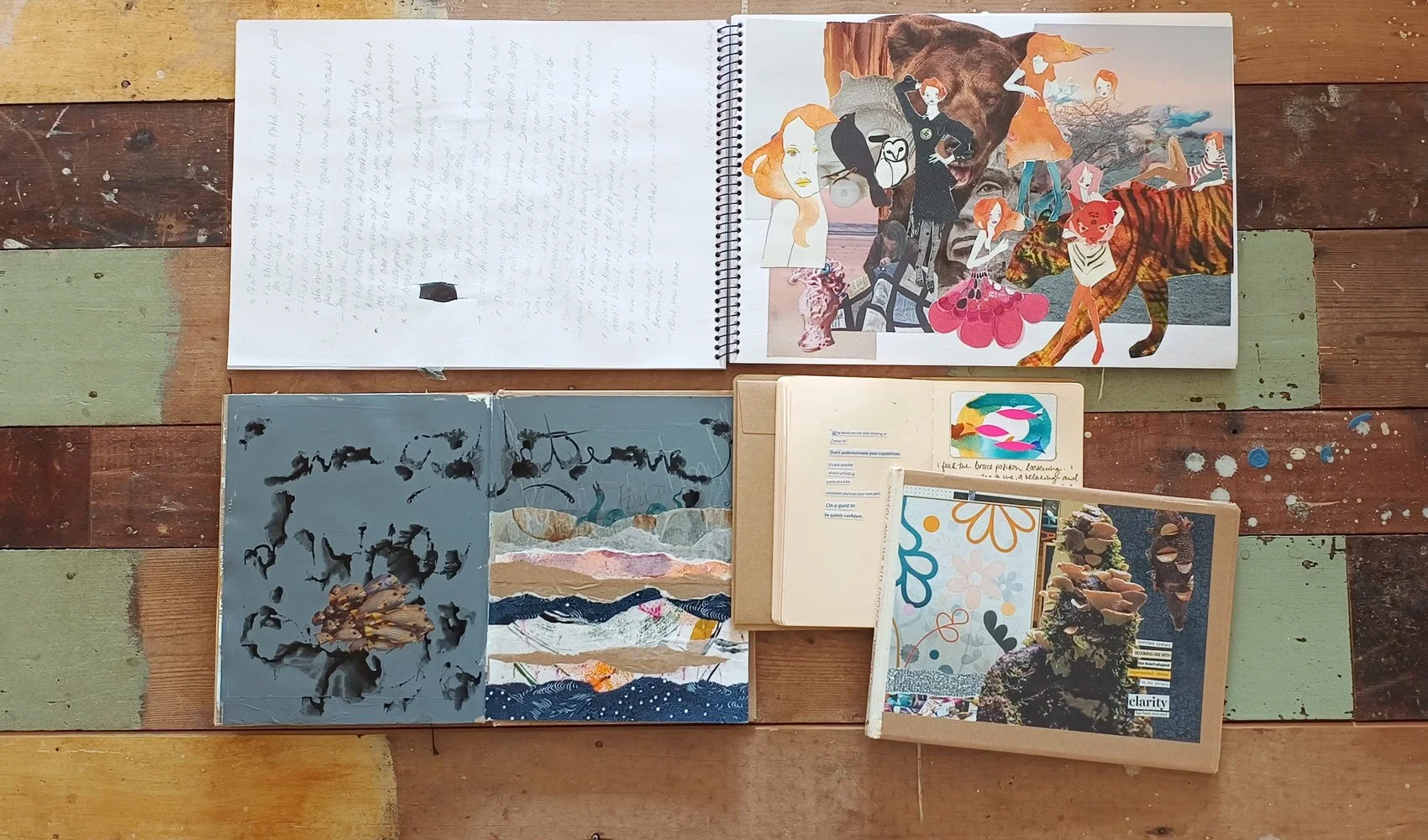
My current range of altered books (bottom row, the ones on the left and right) and studio books using blank sketchbooks. Some are mainly filled with art, some hold found poems and journaling, and in my studio books, I combine writing and visual artmaking.
Practical tips: how to find a good book
If you choose to work with a blank book:
When using a sketchbook, your main considerations are format and paper quality (which are of course both linked to price). Choose something that has the right paper quality for your preferred art materials.
If you envisage using lots of wet media, like watercolour, paint or glue to create collages, look for mixed media paper, 200gsm (grams per square meter) at least.
If you’re more into writing, sketching, drawing, maybe a bit of paint or the odd collage, 120gsm will be ok, as long as you aren’t bothered about paper buckling a little.
If you want to experiment with an altered book, consider these aspects to pick a strong contender:
Paper quality – if it’s too thin it won’t take glue, paints or any wet media (like watercolours) very well.
In your typical textbook, the pages are usually too thin for our arts-based practice and will disintegrate. You can consider gluing pages together to strengthen them or prime them with gesso.
Coffetable books have beautifully thick paper, but it’s often glossy, hence needs priming. Without priming, paint will literally slip off these glossy pages. To prime the pages, you can use gesso or you cover the original book page with another sheet of paper. I often use kraft packing paper, scrap paper, printer or cartridge paper, depending on the media I want to use. Cookbooks can be a good choice in terms of paper quality, too.
Format – this is important to me. Each project asks for its own format; I work in tiny books as well as larger ones. I also like square books, not always easy to find; if a book is a more conventional A4 size, I prefer landscape over portrait… picky, but I know what I like.
Binding – does it open flat so that it’s easy to work in it?
Thickness of the book – if you work in a book that has 200 pages, it might take you years to fill it. You might be ok with that, or you might sense that this could become frustrating. So, depending on your natural level of stamina, choose something you can fill and enjoy as a completed artefact within a reasonable timeframe.
Some people like to consider a book’s title or existing content when they choose their contender for an altered book. This might be relevant if you intend to work with the words or images already in the book rather than seeing it more as a canvas which you intend to cover. Something you can play with!
How to start?
Find a book that you feel drawn to. Charity/ op shops are a good option. Libraries sometimes sell off or give away books. Second-hand bookstores can be a treasure trove. Or you might find something on your own bookshelf, a cookbook you no longer use, a children’s book that is no longer read…
You might want to personalise the cover. Experiment with writing a little manifesto on the first page that captures what you might want to pay attention to or whether this book is about a certain theme or chapter in your life.
If your pages need some priming get some Gesso or prepare them by gluing some sheets of paper onto the original pages. I like having at least a few pages prepared so that I’m ready to go without having to wait for gesso or glue to dry.
Then start playing in your book. Find out what role journaling or writing plays, whether you want to make collages, stick photos in your book, add found poetry, make marks, add stitching, create pockets…
There are no rules, no formulas and no limitations to what you can express and capture in your book.
I have discovered children’s books as a really good option.
They often come in interesting formats; their paper is quite thick (so little hands can grip them and get involved in turning the page without tearing).
Made for bedtime reading, the books themselves are usually thin enough to make it a manageable project you can complete in your lifetime.
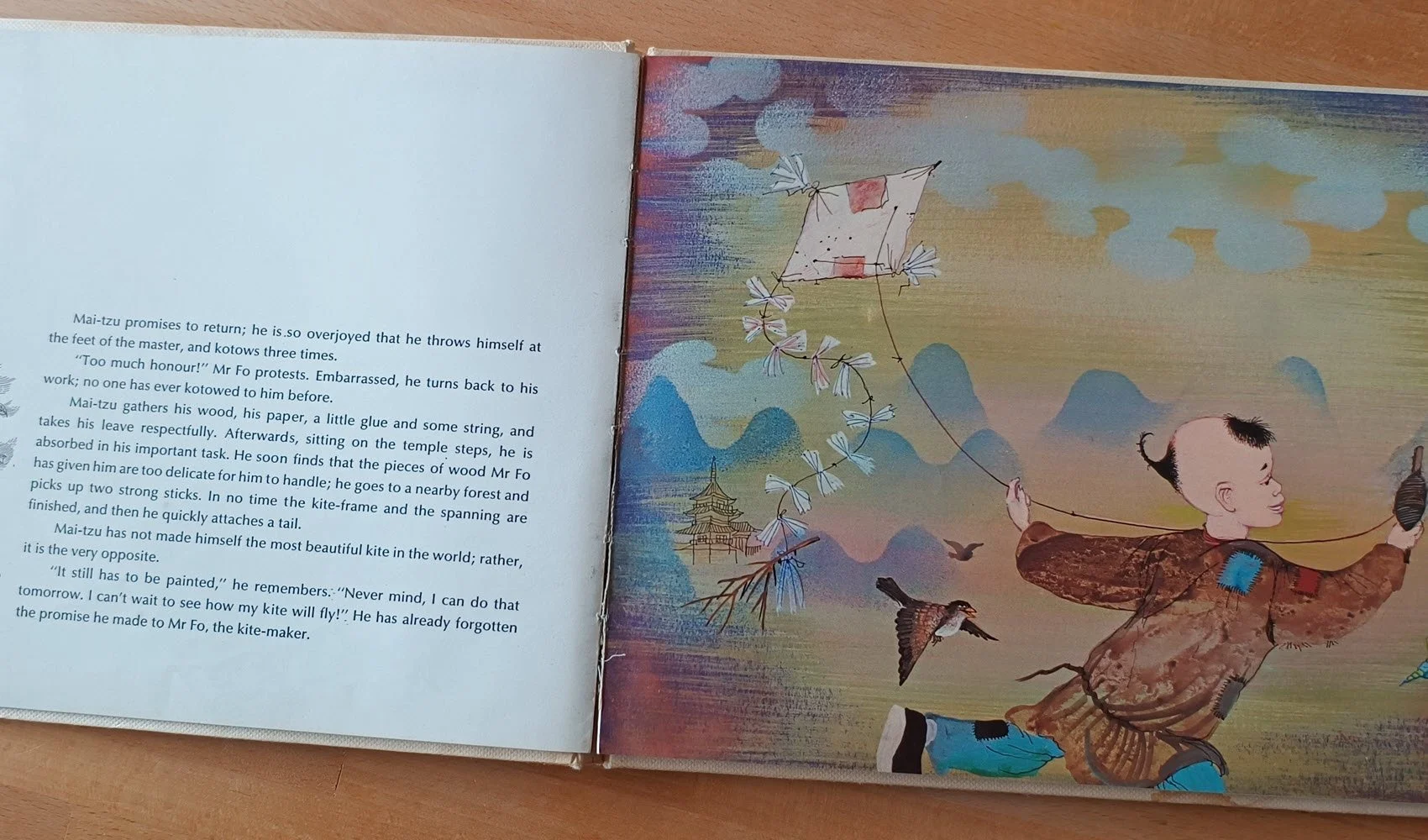
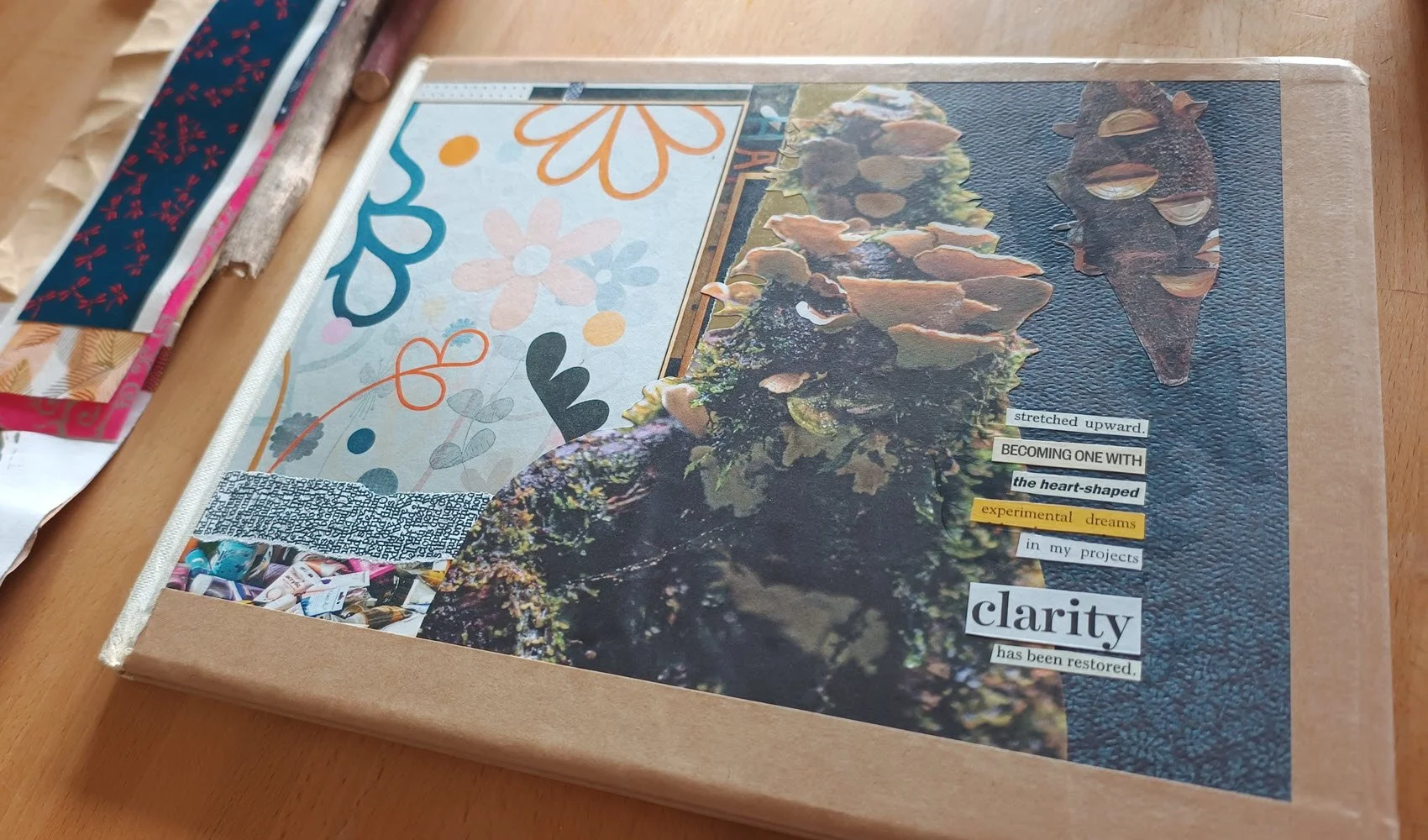
This is my latest $5 second-hand find, a children’s book in a lovely landscape format, with some illustrations that I may keep and integrate in my art.
This book is being turned into my latest project, now with a collage on the cover. I envisage the book as a dialogue between me as the coach and me as the therapist using the left and right pages in juxtaposition. It’ll companion me in the shaping of my work and practice where coaching and therapy meet.
If you yearn for more creativity in your life and want to use it for self-reflection and self-knowledge, let’s chat.
I offer arts-based and trauma-informed coaching in a 1-on-1 setting: book a free Discovery Call or find out more here.
If you’re curious about building a reflective practice that you can stick with, check out my group programs: get in touch or look at current programs.